“Achieving the great rejuvenation of the Chinese nation and Making America Great Again can go hand in hand”.
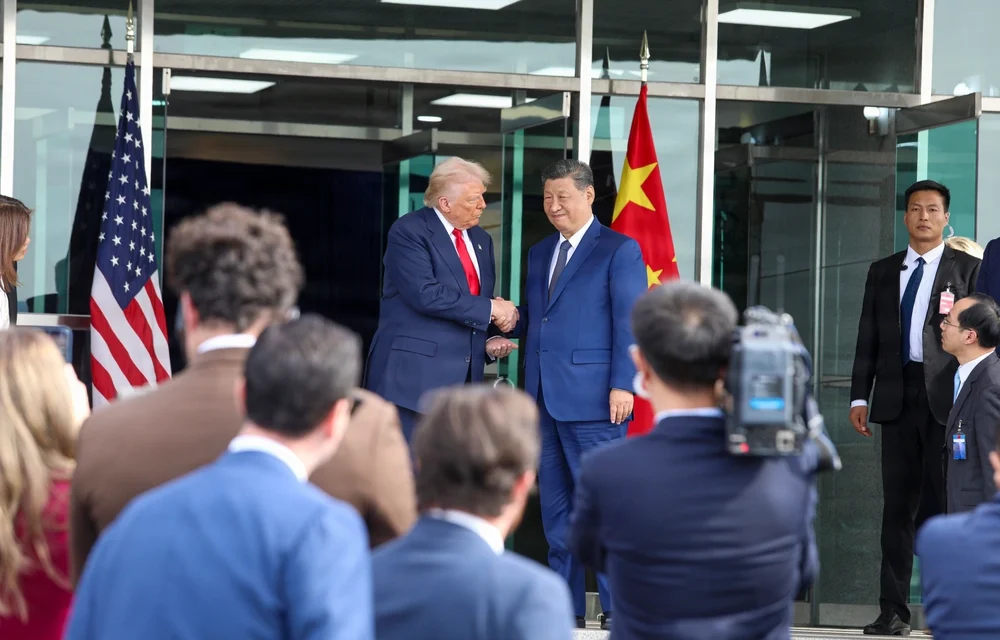
So promised Xi Jinping, President of the People’s Republic of China, in his opening address marking the start of consequential discussions with his counterpart, United States President Donald Trump.
Mr Trump’s 2026 state visit to the PRC has been widely anticipated by political commentators for two key reasons. Firstly, the USA and the PRC are two of the world’s major superpowers that, over the past decade, have not always seen eye to eye. Secondly, combined with the current economic uncertainty exacerbated by war, climate change, and technological disruption, the instinctive desire of both superpowers to compete rather than collaborate has become a common theme in the news cycle.
It is therefore a comforting sight to see both Mr Xi and Mr Trump engage in cordial and warm dialogue to mark the opening of Mr Trump’s state visit, during which sensitive issues will need to be addressed.
It is even more reassuring to hear that discussions over the two-day visit have so far been constructive and positive.
Avoiding the Thucydides’ Trap
A quote from Mr Xi during his opening address has been widely circulated, namely his question: “Can China and the United States overcome the ‘Thucydides Trap’?”.
The Thucydides Trap is a term coined by American political scientist Graham Allison to describe the tendency towards war between an emerging power and an established superpower.
Thucydides, one of history’s first great historians, observed that the destructive Peloponnesian War emerged from conflict between the Greek city-states, in which the emerging power of Athens fought against the then regional superpower, Sparta.
The Thucydides Trap has rightly been criticised by political scientists for its fatalistic assumption that war is inevitable. In fact, Professor Allison himself has praised the diplomacy on display during Mr Trump’s visit and noted the immense opportunity both nations have to create a period of peaceful cooperation in the Pacific.
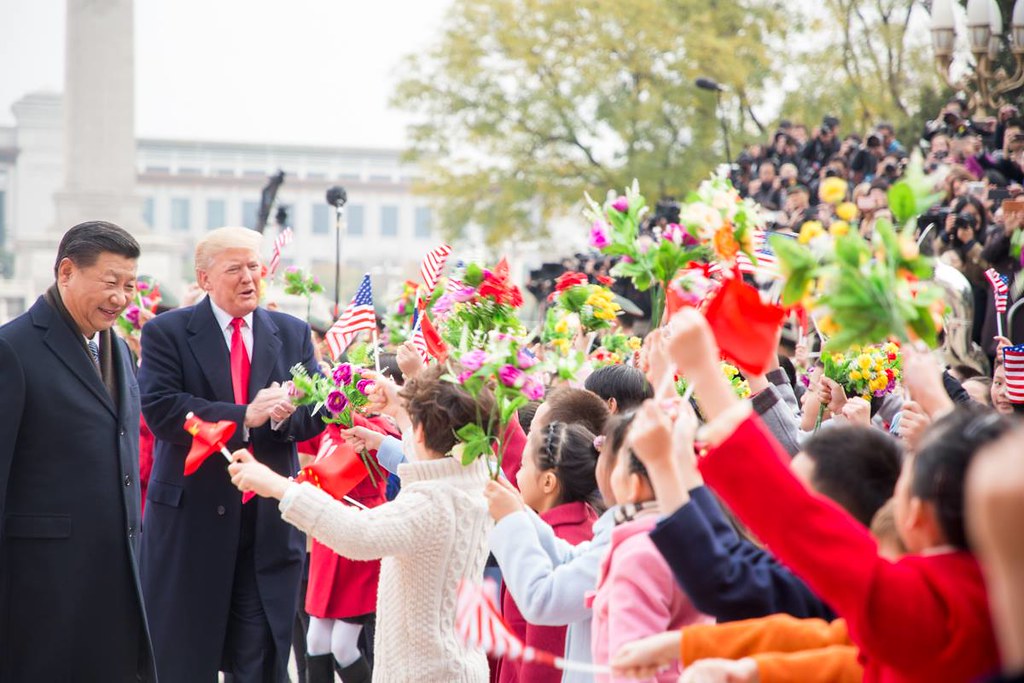
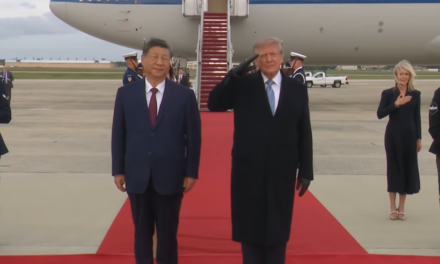
From the beginning of the visit, a certain pomp and ceremony has been noted by observers. Mr Trump’s arrival at the Great Hall of the People was greeted by an honour guard, while a military band performed the American national anthem as part of the ceremony.
Chinese newspapers carried photographs of Mr Trump and Mr Xi posing outside the iconic Temple of Heaven across their front pages. The newspapers further framed the visit as a series of bilateral discussions intended to create “constructive strategic stability”.
The first handshake between Mr Trump and Mr Xi lasted 14 seconds. While viewed as comical by some observers, the symbolism of the act itself suggested both mutual respect between the two men and a desire to demonstrate progress in diplomatic relations.
Perhaps another Thucydides Trap that has gone largely unheralded is the potential conflict between governments and big business.
Both the USA and the PRC are experiencing economic unrest arising from concerns over the rise of artificial intelligence. As with any emerging technology, the disruptions are multifaceted, and the current energy costs, pace of spending, and job displacement associated with AI have led to calls for further regulation in both countries.
Tellingly, Mr Trump’s entourage included not only senior diplomats and government officials, but also Nvidia CEO Jensen Huang and xAI CEO Elon Musk, alongside a host of other business executives. Their presence signals a move towards greater collaboration between American and Chinese markets and businesses.
Early Agreements and Future Promises
It is easy to be carried away by promises made behind closed doors. Yet the summit has so far been successful in addressing key points of contention between the USA and the PRC.
Central to the discussions has been the agreement to secure supply chains and continue economic cooperation between the two nations. These agreements include, but are not limited to, the following:
-The agreement to keep the Strait of Hormuz open for the free flow of energy
-The approval of 10 Chinese companies to buy Nvidia’s H200 chips.
-The Chinese purchase of 200 Boeing planes.
Mr Trump has also stated that an agreement has been reached for China to purchase American crude oil.
Additionally, US Trade Representative Jamieson Greer has stated that an agreement has been reached for China to purchase “double-digit billions” worth of American agricultural produce. CNA further reported that both sides are seeking to identify US$30 billion worth of goods on which trade tariffs could be reduced.
Mr Trump has also invited Mr Xi to the White House for further discussions later this September.
Final Hours of Talks are Promising
As discussions between Mr Xi and Mr Trump draw to a close, it remains to be seen what further agreements will be announced.
Mr Trump, who has long styled himself as a “Peace President”, now has an opportunity to live up to that moniker through further constructive discussions with his Chinese counterpart.
It will take many more discussions before major ongoing issues can be resolved. Climate change and artificial intelligence remain two significant topics that, despite promises of future discussions, have yet to produce substantial agreements.
The current Trump–Xi summit has already accumulated several small wins. Perhaps, in time, these developments will encourage far more ambitious partnerships and achieve “rejuvenation” for the USA, the PRC, and the wider Pacific region.