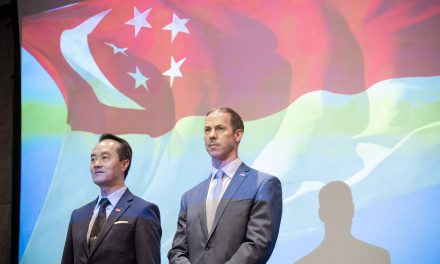

Last week, the 23rd Shangri-La Dialogue (SLD) was hosted by the International Institute for Strategic Studies (IISS) at the Shangri-La Hotel, Singapore. The SLD is one of the world’s most important annual gatherings of defence and security policymakers, military leaders, and academics.
Held from 29 to 31 May 2026, the event brought together representatives from 44 countries, including 54 ministerial-level delegates and 42 chiefs of defence forces.
News outlets have covered the central narrative of the dialogue as one of a renewed commitment to rearmament and the growing push for greater military spending across the world.
However, Singapore’s Defence Minister Mr. Chan Chun Sing, offered an alternate perspective regarding how countries should spend on their defence sectors.
It’s Not All About The Money
In recent years, a combination of domestic political pressures and requests from international allies has contributed to a significant rise in defence spending across the Asia-Pacific region. Between 2024 and 2025, military expenditure in the region increased by an estimated 8.1% to US$681 billion.
While defence spending featured prominently throughout the dialogue and continues to occupy an increasingly important place in national budgets, Mr Chan stressed that expenditure must remain sustainable and be accompanied by corresponding improvements in capability.
“We should not go away with the simplistic thinking that there is a linear correlation between spending and capabilities”, stated Mr Chan.
Instead, two other important considerations must be addressed.
Firstly, defence investment must be accompanied by multilateral cooperation with like-minded partners. This point is especially relevant given how recent conflicts have demonstrated the extent to which war can transcend geographical boundaries and affect global systems, including trade and food security.
In one interview, Mr Chan used the analogy of an airport to illustrate the importance of strategic partnerships. The success of an airport, he argued, is not measured by the number of airlines that operate there, but by the number of connections it provides to the wider world.
Defence expenditure therefore serves not only to build military capability but also to signal a nation’s commitment to regional partnerships and collective security. As Mr Chan noted, “in the defence sector people look at not just capabilities, people look at intention”.
Secondly, defence spending goes hand-in-hand with domestic politics. Countries must therefore maintain strong confidence and social cohesion at home in order to fortify defence capabilities.
“There is no short-cut for solving problems at home. Blaming others will not fix what is broken”, advised Mr Chan.
Mr Chan noted that Singapore’s defence spending has consistently remained at around 3% of GDP and could increase further if necessary because of strong levels of public trust and support.
Additionally, strong domestic politics will enhance a nation’s credibility on the international stage, opening doors for future strategic partnerships in regional defence.
Successes at the SLD
The views expressed by Mr Chan were shared by many leading delegates at the SLD. In his keynote speech to open the event, President of Vietnam, His Excellency Tô Lâm, stated “a sustainable regional order cannot be built on constant fear and mutual distrust”.
Promising talks occurred over the three days. On 30 May, Mr Chan hosted a ministerial roundtable attended by 31 defence ministers and senior representatives. Participants agreed on the need to strengthen defence capabilities proactively in order to improve resilience against future disruptions.
The next morning, Mr Chan hosted breakfast on 31 May with representatives from the Five Power Defence Arrangements (FPDA) member countries. The breakfast reaffirmed the defence commitments first agreed in 1971 between Singapore, Malaysia, Australia, New Zealand and the United Kingdom.
Most significantly, Singapore and 16 other countries launched the Guiding Principles for Underwater Infrastructure Defence Exchanges (GUIDE) on 30 May. The framework aims to strengthen cooperation in protecting critical underwater infrastructure, including telecommunications cables and energy pipelines, which are increasingly recognised as vital components of national security.
As another Shangri-La Dialogue comes to a close, the IISS has published their annual Asia-Pacific Regional Security Assessment for 2026. The publication covers defence concerns over the future of warfare and the need to secure technological advantages and future supply chains.
While calls for increased military spending are likely to continue, one of the clearest messages from this year’s dialogue was that security cannot be measured solely by the size of a defence budget.