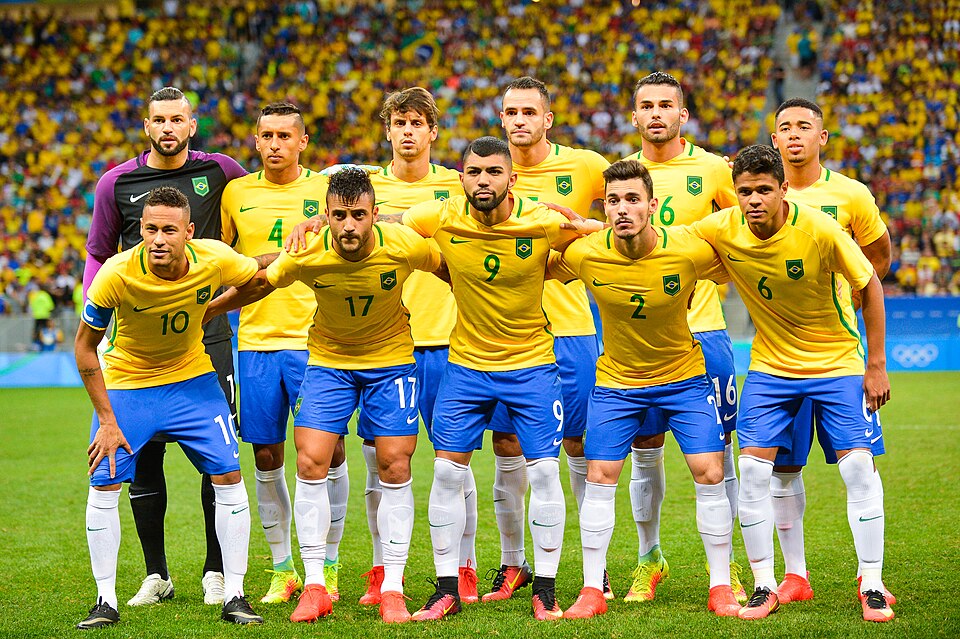
“Passionate” is a term often used to describe football supporters, but to say that Brazilian fans are passionate about football may well be an understatement.
Brazil will once again uphold its reputation as the only South American nation to have appeared in every FIFA World Cup when it takes to the field against Morocco on Sunday, 14 June at 0000 hrs SGT.
Brazil’s Recent World Cup History
Perhaps the most recognisable football team in the world, Brazil’s national team boasts one of the richest histories in World Cup football.
With five World Cup titles, Brazil remains the most successful national team in the history of the tournament.
Although its most recent triumph came in 2002, Brazil has remained remarkably consistent, reaching at least the quarter-finals of every World Cup since 1994. Given this record, many observers expect Brazil to make another deep run in the tournament and perhaps even secure an unprecedented sixth World Cup title.
Interestingly, Brazil is the 7th most populous nation in the world, and as one statistic suggested, 68% of the country’s population are avid national team supporters. Putting this number in perspective, this implies 145 million Brazilians will be actively following the World Cup, not including the vast swaths of international supporters.
In a pleasant twist of fate, Brazil is also witnessing a wave of support from Italian football fans. With the Italian National Team not participating in this year’s World Cup, the European nation will instead be represented by Carlo Ancelotti, the new manager for the Brazilian National Team. Even the Italian Minister of Sports has publicly announced his support for Ancelotti at this World Cup.
Ancelotti has won virtually all major trophies at a club level. A triumph for Brazil would also mean a triumph for one of the great managers of football.
Three Questions with Brazil’s Ambassador
His Excellency Luciano Mazza de Andrade accepted Diplomatic Network (Asia)’s request for an interview about how football has shaped Brazil’s national identity and international image. We wanted to understand how Brazilians view the sport through the lens of their national team.
Q: Brazilian fans are renowned around the world as some of the most passionate supporters of their national team. Do Brazilians love other sports and tournaments as much as football, and if so, what is it about Brazilian culture that creates such strong lifelong fans?
No sport can rival football in the hearts of Brazilians, but other sports such as volleyball, “futsal”, and basketball also have dedicated followings. It’s team sports that are particularly popular in Brazil: there is something dramatic and exciting about people coming together in a team, bringing their individual talents to bear and trying to overcome adversity. There is also an important social dimension. It is a collective sport that unites Brazilians when they are playing, watching or talking about the games, even when they are supporting different teams.
Q: South America’s CONMEBOL is arguably the most competitive football confederation in the world, where Brazil often faces footballing giants such as Argentina, Uruguay, Colombia, and Ecuador. Going into the World Cup, do Brazilians feel a sense of continental solidarity with their neighbours and celebrate one another’s victories?
Our neighbours in South America are our family – but you know how heated sibling rivalries can get… I think Brazilians are always happy to see a South American team prevail against an opponent from another part of the world – but when we play against each other, we play to win – especially because we know that our neighbours are some of the most talented opponents we’ll face!
Q: Brazil last hosted the World Cup in 2014. Now that twelve years have passed, how has that experience benefited Brazil’s international image, and do the benefits of hosting the World Cup outweigh its challenges?
The World Cup in Brazil was a wonderful moment, a chance for us to welcome the world and demonstrate the diversity of peoples, cultures, and biomes that make up Brazil. It’s always a challenge to host such a massive, complex event, but when we succeed, it’s an opportunity to show both ourselves and the world what we are capable of. And that legacy continues: in 2027, Brazil will host the FIFA Women’s World Cup, another chance to welcome the world and showcase what we can do.